Welding Safety — PPE, Hazards and Best Practices
Introduction
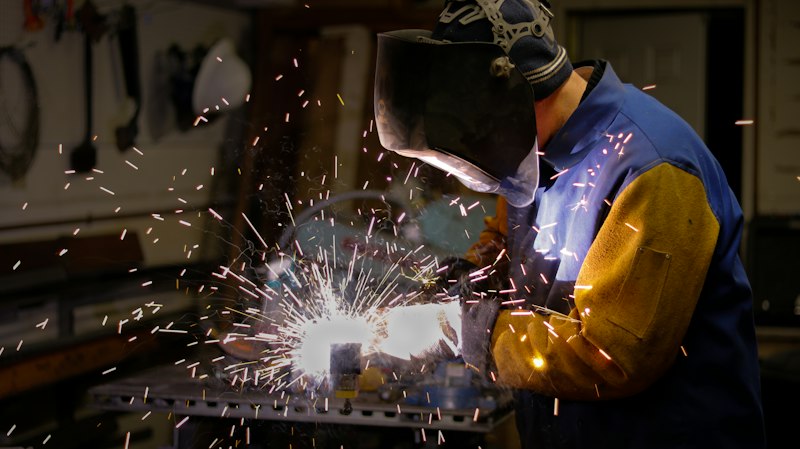
Welding involves significant hazards: radiation, toxic fumes, electric shock, burns, fire and explosion. Knowing these risks and using appropriate PPE is every welder's responsibility and a legal requirement across Europe.
---
Personal Protective Equipment (PPE)
| PPE | Protects against | Standard |
|---|---|---|
| Welding helmet (auto-darkening) | UV/IR radiation, sparks | EN 379, EN 175 |
| Safety glasses | Flying particles (grinding) | EN 166 |
| Welding gloves (leather) | Burns, radiation | EN 12477 |
| Leather apron | Sparks and spatter | EN ISO 11611 |
| Safety boots (steel toe) | Falling objects | EN ISO 20345 (S3) |
| Hearing protection | Noise (grinding, gouging) | EN 352 |
| Respiratory mask | Welding fumes | EN 149 (FFP2/FFP3) |
---
Main Hazards
1. UV/IR Radiation
The arc emits intense UV that causes skin burns and eye injuries ("arc eye"). Prevention: helmet with correct shade, covered skin.
2. Fumes and Gases
Metal particles (manganese, chromium, nickel, zinc) and gases (ozone, CO, NOx). Prevention: ventilation, local extraction, FFP2/FFP3 mask.
3. Electric Shock
Open circuit voltage up to 80V. Prevention: check cables, dry gloves, equipment in good condition.
4. Fire and Explosion
Sparks igniting combustibles. Prevention: clear area 10 m, fire extinguisher, fire watch post-work.
5. Confined Spaces
Asphyxiation, fume accumulation. Prevention: permit, continuous O₂ monitoring, forced ventilation, standby person.
---
Safety Certifications in Europe
| Certification | Country | Content |
|---|---|---|
| VCA/SCC | Netherlands, Belgium, Germany | Industrial safety |
| PRL / TPM | Spain | Occupational risk prevention |
| CSIP | France | Professional safety card |
---
*Article based on Directive 89/656/EEC and EN ISO 11611. Published on WeldFC Academy.*