Shielding Gases in Welding — Complete Technical Guide (EN ISO 14175)
Introduction
Shielding gases play a critical role in gas-shielded arc welding processes — MIG/MAG (GMAW 131/135), TIG (GTAW 141) and FCAW (136/137). Their primary function is to protect the weld pool, filler metal droplets and the solidifying weld bead from atmospheric contamination (oxygen, nitrogen and water vapour), which cause porosity, oxidation and embrittlement of the weld.
But gases do far more than just protect. They directly influence arc stability, metal transfer mode, penetration, bead morphology, spatter and the mechanical properties of the welded joint. The correct gas selection is as important as the choice of consumable or electrical parameters.
The reference standard is EN ISO 14175:2008 — *Welding consumables — Gases and gas mixtures for fusion welding and allied processes*.
---
EN ISO 14175 Classification
EN ISO 14175 classifies gases and gas mixtures into groups and subgroups based on their composition and reactivity. The designation follows the format:
ISO 14175 – Group Subgroup (example: ISO 14175 – M21)
Main groups
| Group | Designation | Composition | Behaviour |
|---|---|---|---|
| I | Inert | Ar, He or Ar+He mixtures | No chemical reaction with weld pool |
| M1 | Low-active mixture | Ar + ≤5% CO₂ or ≤3% O₂ | Slightly oxidising |
| M2 | Active mixture | Ar + 5–25% CO₂ or 3–5% O₂ | Moderately oxidising |
| M3 | Highly active mixture | Ar + >25% CO₂ or >5% O₂ | Strongly oxidising |
| C | Pure active | Pure CO₂ or CO₂ + ≤30% O₂ | Strongly oxidising |
| R | Reducing | Ar or He + H₂ | Reducing (stainless and Ni) |
| N | Low reactivity | Pure N₂ or N₂ + ≤5% others | Low reactivity |
| O | Pure oxidising | Pure O₂ | Strongly oxidising (cutting) |
Most common industrial subgroups
| Designation | Typical Composition | Main Application |
|---|---|---|
| I1 | 100% Ar | TIG all materials; MIG aluminium, stainless, copper |
| I2 | 100% He | TIG/MIG copper and thick alloys (high conductivity) |
| I3 | 70–75% Ar + 25–30% He | TIG/MIG aluminium and copper (penetration/cost balance) |
| M12 | Ar + 2–3% CO₂ | MAG stainless and thin sheet (low oxidation) |
| M13 | Ar + 1–3% O₂ | MAG stainless and carbon steel thin sheet |
| M20 | Ar + 5–10% CO₂ | MAG thin and medium sheet |
| M21 | Ar + 15–25% CO₂ | MAG carbon steel (the most universal) |
| M23 | Ar + 18% CO₂ + 2% O₂ | MAG carbon steel (better surface appearance) |
| M31 | Ar + 30–50% CO₂ | MAG carbon steel (high penetration) |
| C1 | 100% CO₂ | MAG carbon steel (maximum penetration, more spatter) |
| R1 | Ar + 2–5% H₂ | TIG austenitic stainless and nickel alloys |
| R2 | Ar + 5–15% H₂ | Plasma and TIG orbital stainless |
---
Individual Gas Properties
Argon (Ar)
| Property | Value |
|---|---|
| Type | Inert |
| Density relative to air | 1.38 (heavier — good coverage) |
| Ionisation potential | 15.76 eV (low — easy arc initiation) |
| Thermal conductivity | Low |
| Minimum purity | 99.995% (grade 4.5) for TIG; 99.95% (grade 3.5) for MIG |
Argon is the most widely used shielding gas. Its low ionisation potential facilitates arc initiation and stability. Being heavier than air, it provides excellent weld pool coverage. Used pure in TIG for all materials and in MIG for non-ferrous metals. In MAG, it is always combined with active gases.
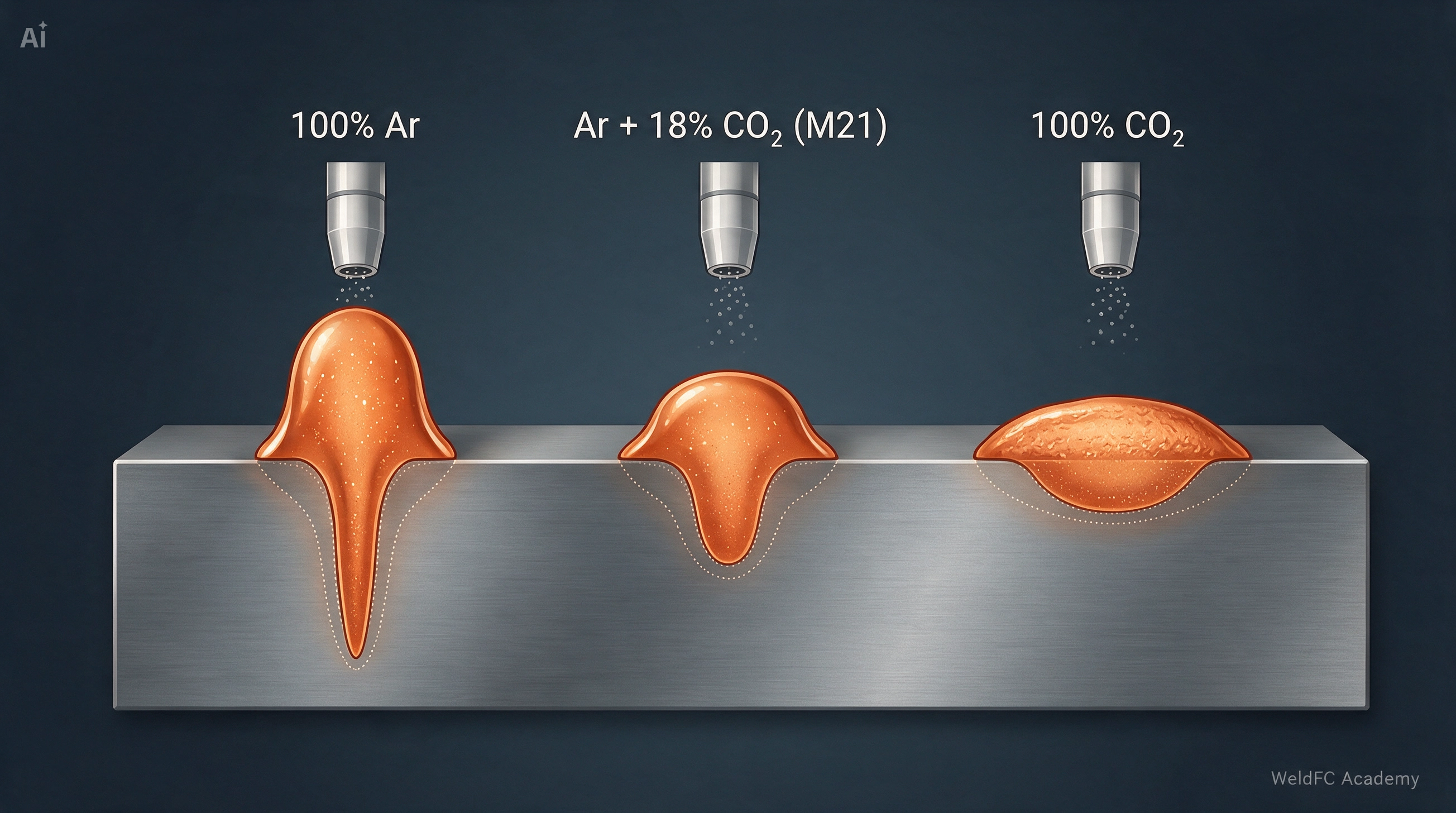
The low thermal conductivity of pure argon produces a "finger-like" penetration profile — narrow and deep at the centre, with little fusion at the edges. This profile promotes lack of sidewall fusion in fillet joints.
Carbon Dioxide (CO₂)
| Property | Value |
|---|---|
| Type | Active (oxidising) |
| Density relative to air | 1.53 (heavier than Ar) |
| Ionisation potential | 14.4 eV |
| Thermal conductivity | High |
| Minimum purity | 99.5% (grade 2.5); ≤0.025% H₂O |
CO₂ is an active gas that dissociates in the arc into CO + O. The released oxygen reacts with the weld pool (oxidation), but the high arc energy and thermal conductivity produce deep penetration and a wide bead. Trade-offs: more spatter, rougher surface and loss of alloying elements (Mn, Si) through oxidation.
Used pure (C1), it is the most economical gas for MAG on carbon steel. Spray transfer is not possible with pure CO₂ — only short-circuit and globular.
Helium (He)
| Property | Value |
|---|---|
| Type | Inert |
| Density relative to air | 0.14 (much lighter — requires higher flow rates) |
| Ionisation potential | 24.56 eV (high — harder arc maintenance) |
| Thermal conductivity | Very high |
| Minimum purity | 99.995% (grade 4.5) |
Helium has high thermal conductivity, resulting in a hotter arc and a wide, parabolic penetration profile — ideal for high-conductivity materials like thick aluminium and copper. It is significantly more expensive than argon and, being lighter than air, requires 2–3× higher flow rates for equivalent coverage.
Oxygen (O₂)
Added in small quantities (1–5%) to argon mixtures to improve wettability and arc stability in MAG welding of carbon steel and stainless steel. Reduces weld pool surface tension, producing flatter beads with better toe wetting.
Hydrogen (H₂)
Used only with austenitic materials (austenitic stainless, nickel alloys) and never with carbon, ferritic or martensitic steels (causes hydrogen-induced cold cracking). In R1/R2 mixtures (2–15% H₂ + Ar), hydrogen acts as a reducing agent, producing brighter, cleaner beads with good wettability.
Nitrogen (N₂)
Low-cost gas used as purge gas (backing gas) in TIG welding of stainless steel, and in small additions (1–2%) to argon mixtures for duplex stainless steel (stabilises the austenite phase).
---
Gas Selection by Process and Material
MIG/MAG — Carbon and Low-Alloy Steel
| Mixture | ISO Designation | Transfer | Spatter | Penetration | Typical Use |
|---|---|---|---|---|---|
| 100% CO₂ | C1 | Short-circuit / Globular | High | Deep | General construction, heavy structures |
| Ar + 8% CO₂ | M20 | Short-circuit / Spray | Low | Medium | Thin and medium sheet; robotics |
| Ar + 18% CO₂ | M21 | Short-circuit / Spray | Moderate | Good | Most versatile — general purpose |
| Ar + 25% CO₂ | M21/M31 | Short-circuit | Moderate | Deep | Medium thicknesses; root pass |
| Ar + 18% CO₂ + 2% O₂ | M23 | Spray | Low | Good | Better appearance; robotic welding |
Practical recommendation: For most carbon steel applications, Ar + 18% CO₂ (M21) is the universal mixture.
MIG — Austenitic Stainless Steel
| Mixture | ISO Designation | Effect |
|---|---|---|
| Ar + 2% CO₂ | M12 | Minimum oxidation; good appearance; general use |
| Ar + 2% O₂ | M13 | Better wettability; clean surface |
| 100% Ar | I1 | No oxidation but unstable arc in spray |
Rule: in stainless steel, keep CO₂ ≤ 3% to avoid weld carburisation and degradation of corrosion resistance.
MIG — Aluminium and Light Alloys
| Mixture | ISO Designation | Effect |
|---|---|---|
| 100% Ar | I1 | Standard for Al up to 8 mm |
| Ar + 25% He | I3 | Better penetration on thicknesses >8 mm |
| Ar + 50% He | I3 | Thicknesses >15 mm; reduces porosity |
| Ar + 75% He | I3 | Maximum penetration; thicknesses >20 mm |
Aluminium requires inert gas. Any active gas (CO₂, O₂) causes severe oxidation and unacceptable porosity.
TIG (GTAW 141)
| Mixture | ISO Designation | Application |
|---|---|---|
| 100% Ar | I1 | Standard — all materials |
| Ar + 25–50% He | I3 | Copper and thick aluminium (more heat) |
| Ar + 2–5% H₂ | R1 | Austenitic stainless; faster travel and brighter finish |
| Ar + 5–15% H₂ | R2 | Orbital TIG stainless; nickel alloys |
FCAW (136/137)
| Process | Gas | Application |
|---|---|---|
| FCAW-G (136) | 100% CO₂ (C1) | Flux-cored wire with gas shielding — carbon steel |
| FCAW-G (136) | Ar + 25% CO₂ (M21) | Flux-cored wire — better appearance, less spatter |
| FCAW-S (114) | None (self-shielded) | Self-shielded wire — no external gas |
---
Gas Influence on Bead Morphology
| Parameter | 100% Ar | Ar + 18% CO₂ | 100% CO₂ |
|---|---|---|---|
| Penetration profile | Finger-like — narrow and deep | Intermediate — balanced | Wide and rounded |
| Bead width | Narrow | Medium | Wide |
| Reinforcement height | High | Medium | Low |
| Wettability | Poor (high surface tension) | Good | Very good |
| Spatter | Minimal | Moderate | High |
| Surface appearance | Very smooth, bright | Good, slight oxidation | Rough, oxidised |
---
Gas Flow Rates
| Process | Nozzle Diameter (mm) | Recommended Flow Rate (l/min) |
|---|---|---|
| MAG short-circuit | 12–16 | 10–14 |
| MAG spray | 16–20 | 14–20 |
| MIG aluminium | 16–22 | 15–22 |
| TIG manual | 6–12 | 6–12 |
| TIG orbital | 8–12 | 8–15 |
| FCAW-G | 16–20 | 15–22 |
| Pure He or >50% He mixtures | — | 2–3× values above |
Rule of thumb
Flow rate (l/min) ≈ nozzle diameter (mm) × 1.0 to 1.2
---
Storage and Safety
| Parameter | Requirement |
|---|---|
| Cylinders | Store upright, chained; protect from heat and direct sunlight |
| Pressure (Ar) | 150 or 200 bar (standard); 300 bar (composite lightweight) |
| Colour code EN 1089-3 | Ar = dark green; CO₂ = grey; He = brown; O₂ = white; H₂ = red; N₂ = black |
| CO₂ hazards | Asphyxiation in confined spaces (CO₂ is heavier than air, pools at floor level) |
| Ar hazards | Same asphyxiation risk as CO₂ (displaces oxygen) |
| H₂ hazards | Flammable and explosive — never use near open flame |
| Regulators | Gas-specific; never use O₂ regulators on flammable gases |
---
Defects Caused by Gas Problems
| Defect | Cause | Solution |
|---|---|---|
| Widespread porosity | Insufficient flow rate; hose leak; blocked nozzle | Check flow; test for leaks; clean nozzle |
| Surface porosity | Draughts at work location | Increase flow or use physical barrier |
| Excessive oxidation | Excess CO₂ or O₂; contaminated gas | Reduce active gas %; check purity |
| Cold cracking | H₂ in gas used on carbon/ferritic steel | Use H₂-free gas; never R1/R2 on ferrous |
| Unstable arc | Excessive flow (turbulence); faulty regulator | Reduce flow; replace regulator |
| Lack of sidewall fusion | Pure Ar in MAG steel (finger penetration) | Use mixture with CO₂ (M21) |
---
Cost Comparison
| Gas | Relative Cost | Cost per Hour (estimate) |
|---|---|---|
| Pure CO₂ | 1× (baseline) | €0.30–0.50/h |
| Ar + 18% CO₂ | 2–3× | €0.80–1.50/h |
| 100% Ar | 3–4× | €1.00–2.00/h |
| Ar + 25% He | 5–7× | €2.00–4.00/h |
| 100% He | 8–12× | €4.00–8.00/h |
Gas cost typically represents 2–5% of total welding cost (the largest cost is labour). Saving on gas at the expense of quality or productivity is almost always a poor investment.
---
Reference Standards
| Standard | Content |
|---|---|
| EN ISO 14175 | Classification of gases and gas mixtures for welding |
| EN 1089-3 | Colour coding for gas cylinder identification |
| EN ISO 14341 | Classification of solid wires for MAG |
| EN ISO 18276 | Flux-cored wires for MAG |
| ISO 15614-1 | Procedure qualification — gas is an essential variable |
---
*Technical article based on EN ISO 14175:2008, AWS Welding Handbook — EWE/IWE Module 1.8 MIG/MAG Process, Lincoln Electric — The Procedure Handbook of Arc Welding and AWS Welding Handbook Vol. 1. Published on WeldFC Academy.*