MIG/MAG Welding Process (131/135) — Complete Guide
Introduction
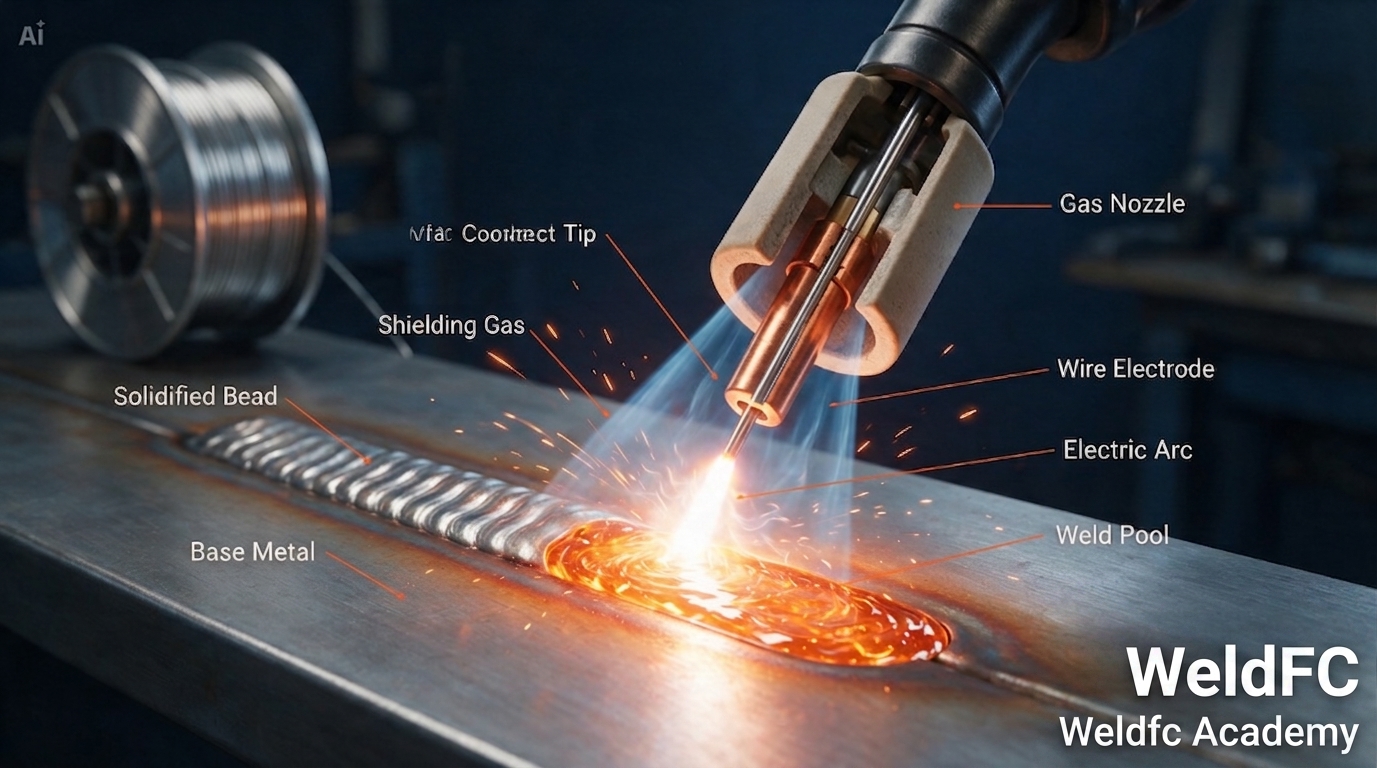
MIG/MAG (Metal Inert Gas / Metal Active Gas), also known as GMAW (Gas Metal Arc Welding), processes 131 (MIG) and 135 (MAG) per ISO 4063, is the most widely used semi-automatic welding process in industry. It uses a continuous solid wire as consumable electrode with external shielding gas.
- MIG (131): Inert gas (Ar, He) → aluminium, copper, titanium
- MAG (135): Active gas or mixture (CO₂, Ar+CO₂) → carbon steel, stainless
---
Transfer Modes
| Mode | Current | Characteristics | Application |
|---|---|---|---|
| Short-circuit (dip) | Low (50-180A) | Low heat, some spatter | Thin sheet, roots, positional |
| Globular | Medium | Large drops, irregular | Rarely used (transition zone) |
| Spray | High (>200A) | Fine drops, stable arc, high deposition | Flat and horizontal |
| Pulsed | Pulsed | Combines spray + short-circuit, no spatter | All positions, thin to thick |
---
Key Parameters
| Parameter | Effect |
|---|---|
| Wire feed speed (m/min) | Controls current and deposition rate |
| Voltage (V) | Controls arc length and bead width |
| Travel speed | Affects heat input and geometry |
| Stick-out (CTWD) | Contact tip to work distance (10-20 mm) |
| Gas flow (l/min) | Pool protection (12-18 l/min for Ar+CO₂) |
---
Common Wires
| Classification | Composition | Application |
|---|---|---|
| ER70S-6 / G3Si1 | C-Mn-Si | Universal — most common |
| Diameters: 0.6, 0.8, 1.0, 1.2 mm | — | Thin to thick sections |
---
Advantages and Disadvantages
Advantages: High productivity, easy automation, no slag, all positions, high duty cycle (~60%), wide thickness range.
Disadvantages: Sensitive to wind, more complex equipment than SMAW, difficult access in confined spaces.
---
*Article based on AWS Welding Handbook materials and ISO 4063. Published on WeldFC Academy.*